
Understanding the different types of dementia
Read
Enquire now to find out more about our tailored visiting and live-in care packages for your loved one.
Enquire nowVisiting care vs live-in care: discover the key differences and find out which type of homecare best suits your loved one's needs, routine and level of independence.
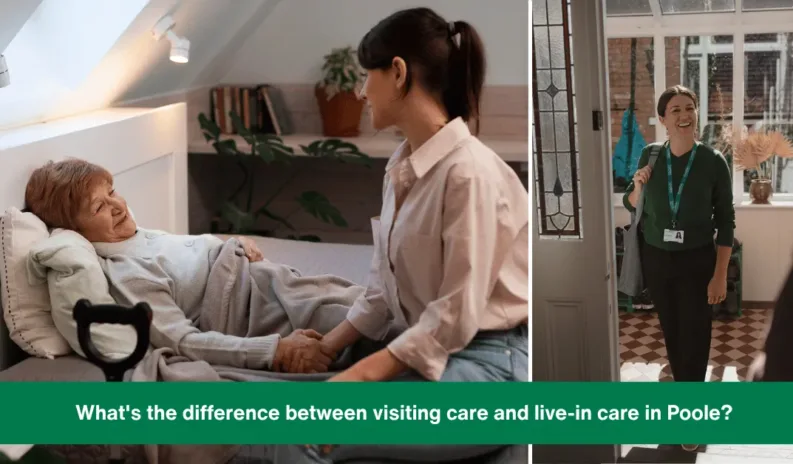
Visiting care vs live-in care: understanding the differences can help you choose the right level of support for your loved one, from scheduled visits at home to more continuous, personalised care. Families often come to us not knowing which option even applies to their situation, and that’s a completely normal place to start.
Visiting care means a care professional comes to your loved one’s home for set visits throughout the day, to help with specific tasks like getting up, meals or medication. Live-in care means one dedicated care professional actually lives in the home, providing round-the-clock support and company. Which one is right depends on how much support your loved one needs, and how much company they’d like alongside it.
Visiting care means a care professional comes to your loved one’s home at set times during the day, perhaps first thing in the morning to help with washing and getting dressed, again at lunchtime for a meal and medication, and again in the evening to help someone settle for the night. Visits can be as short as thirty minutes or considerably longer, depending on what’s needed.
Visits arrive reliably at the times agreed, and your loved one will usually see the same small team of care professionals rather than a constantly changing rota, so familiar, trusted faces become part of the routine.
Visiting care suits people who are largely independent but need support with particular parts of the day, or who want company a few times a week rather than constant supervision.
Live-in care means one dedicated care professional actually lives in your loved one’s home, providing support around the clock rather than at set visit times. Their day is woven around your loved one’s own routine, personal care, meals, medication, mobility and companionship, with a proper daily break built in so the arrangement stays sustainable for everyone involved.
This tends to suit people who need more continuous support, have fluctuating needs through the day and night, or simply want the reassurance and company of someone else in the home. It can also work well for couples, since one care professional can often support both people together.
The clearest way to work this out is to think about how your loved one spends their day, and where the gaps in support actually are. If they manage well alone but need a hand with specific tasks, visiting care is often the natural starting point.
If they need consistent support throughout the day and night, or would benefit from having someone there all the time, live-in care is worth exploring properly.
It’s also worth knowing that needs can change over time, and it’s entirely possible to move from visiting care to live-in care, or adjust the level of visiting support, as circumstances shift.
1. What’s the difference between a visiting carer and a live-in carer?
A visiting carer comes to the home for scheduled visits throughout the day, while a live-in carer is based in the home full time, providing continuous support.
2. Is live-in care more expensive than visiting care?
It depends on the level of support needed. For lower support needs, visiting care is often less expensive, but for higher or more constant needs, live-in care can work out comparable, particularly for a couple sharing one care professional.
3. Can visiting care turn into live-in care later on?
Yes. Many families start with visiting care and move to live-in care as needs increase, and the transition can be managed without disrupting your loved one’s routine.
4. Do carers get breaks during a live-in placement?
Yes. Live-in carers have a daily break built into every day, so the arrangement stays sustainable and personal rather than stretched thin. If your loved one can’t be left alone, the office can support you with cover during that time.
5. Which care option is better for someone with dementia?
Both visiting and live-in care can work well, depending on the stage of dementia and the person. Visiting care can suit earlier stages with lighter support needs, while live-in care often suits later stages where consistency and familiar company matter more.
Both options can be tailored to the individual, helping them remain in the comfort of their own home for as long as it is safe and appropriate.
If you’re trying to work out which option is right for someone in Poole, Bournemouth or anywhere across the BCP area, we would love to help. Please get in touch with our friendly GoodOaks Homecare Bournemouth and Poole office, or send us a message through our website, and we can arrange a free needs assessment to talk through what would genuinely suit your loved one. There’s no pressure, whatever you decide.