


Summer safety for elderly parents in Maidenhead: Staying safe in the heat
Read
Enquire now to find out more about our tailored visiting and live-in care packages for your loved one.
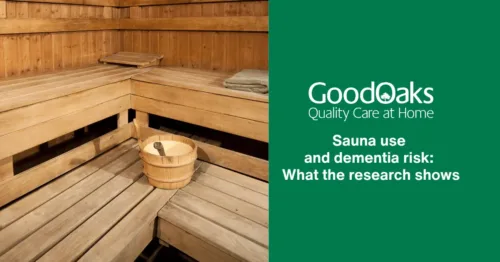
Enquire nowSauna use and dementia risk is an area attracting growing research interest, with studies exploring whether regular sauna bathing may be associated with a lower risk of dementia.

At GoodOaks Woodford Green, we’re always interested in the small, everyday things that can contribute to healthy ageing and wellbeing. Sauna use and dementia risk is one area that has attracted growing attention, with research exploring whether regular sauna bathing may be associated with a lower risk of dementia.
What’s particularly interesting is that sauna bathing isn’t a new wellness trend. Cultures around the world have been using heat, bathing and communal relaxation as part of everyday life for generations.
Some of the most interesting research into sauna use comes from Finland, where saunas are very much part of everyday life.
The landmark Kuopio Ischaemic Heart Disease (KIHD) study followed more than 2,300 middle-aged Finnish men for around two decades. Researchers found that men who used a sauna four to seven times a week had a 66% lower risk of developing dementia and a 65% lower risk of Alzheimer’s disease than those who used a sauna once a week. Even those using a sauna two to three times a week showed a lower risk.
A separate, much larger Finnish study followed almost 14,000 men and women for up to 39 years. It also found that more frequent sauna bathing was associated with a lower risk of developing dementia later in life.
These findings are certainly interesting, but it’s important to understand what the research does and doesn’t tell us. These studies found an association between sauna use and dementia risk; they don’t prove that using a sauna prevents dementia.
So why might there be a connection?
Researchers aren’t entirely sure, but the leading theory is that regular heat exposure benefits the cardiovascular system in a way that mirrors moderate aerobic exercise – improving blood vessel function, lowering blood pressure, and boosting circulation.
The relaxation and stress-reducing effects of sauna use may also contribute to overall wellbeing.
Dementia research isn’t the only reason sauna use has attracted attention in healthy ageing.
Regular sauna bathing has also been associated with:
It’s important to remember that sauna use isn’t a replacement for physical activity. Where an older person is able to exercise safely, movement remains important for maintaining strength, mobility, balance and overall health.
Sauna use isn’t suitable for everyone, particularly older people who are frail or living with certain health conditions.
Heat exposure raises heart rate and can affect blood pressure and hydration. Some medical conditions and medications can also affect how someone responds to heat.
If an older person is considering using a sauna for the first time, or increasing how often they use one, it’s sensible to speak to their GP or healthcare professional first.
If sauna use is considered appropriate, it should be approached gently, with careful attention to temperature, duration and hydration. Anyone feeling dizzy, faint or unwell should leave the sauna and cool down.
As with any wellbeing activity, what’s safe and appropriate will vary from person to person.
A tradition much older than the research
What’s striking about the Finnish findings is that they’re really catching up with something many cultures have practised – and trusted – for centuries.
Although these traditions are very different, they have something in common: heat bathing has often been about connection as well as the physical experience.
It’s an opportunity to slow down, relax and spend time with other people. For older adults, maintaining social connections and having opportunities to take part in enjoyable activities can be an important part of overall wellbeing.
For families across Woodford Green, South Woodford, Loughton and Waltham Forest, the takeaway isn’t necessarily that an older relative should start using a sauna.
For some older or frailer people, sauna use simply may not be appropriate. But the research does offer an interesting reminder that healthy ageing isn’t only about medical care. Everyday routines that encourage relaxation, movement, social connection and enjoyment can all contribute to wellbeing.
If you’re supporting a parent or relative and wondering whether an activity such as sauna bathing could be appropriate for them, it’s always worth discussing it with their GP first.
Our GoodOaks Woodford Green team can also help families think about practical ways to support independence, companionship and wellbeing as part of a person’s wider care routine.
Families in the area may also be interested in Lowlu, a London-based sauna and cold plunge operator with a site in Ilford, one of the closer options for families in Woodford Green, South Woodford and the wider Redbridge area.
Lowlu offers traditional Finnish-style saunas alongside cold plunge and relaxation spaces, bringing elements of Nordic sauna culture to local communities across London.
GoodOaks Woodford Green is partnering with Lowlu to explore an elderly-specific programme, with sessions tailored around the needs and comfort of older people rather than simply adapting a general public offering.
In keeping with the traditions explored above, the idea is about more than heat alone. A session can also provide an opportunity to slow down, socialise and enjoy a different kind of wellbeing experience.
We’re excited to explore what this could look like for older people in our local community, while keeping safety, individual needs and comfort at the heart of the programme.
If you’re looking for support to help an older loved one remain independent and enjoy life at home, GoodOaks Homecare Woodford Green is here to help. Get in touch with our local team to find out more.