


Stay connected with the GoodOaks Family App
Read
Enquire now to find out more about our tailored visiting and live-in care packages for your loved one.
Enquire nowTravelling with loved ones across three generations is becoming an increasingly popular way for families to reconnect and create lifelong memories.

Family holidays are changing. Rather than travelling only with partners and children, more families are choosing to bring grandparents, adult children and grandchildren together for one shared trip. As these holidays become more popular, live-in care for multigenerational holidays can help older loved ones travel safely, comfortably and confidently alongside their families.
Known as multigenerational travel, this trend can include three or more generations taking a holiday together. It may be a large family villa in Spain, a cruise, a countryside break in the UK, a visit to relatives overseas or a special trip to celebrate a birthday or anniversary.
For older people living in Woodford Green, South Woodford, Buckhurst Hill and the surrounding areas, ageing or needing additional care should not automatically mean missing out. With realistic planning and the right support, a live-in care professional can help make a family holiday safer, more comfortable and more enjoyable for everyone.
The desire to travel remains extremely strong among UK families. ABTA reported that 87% of UK adults took a holiday during the 12 months to July 2025, the highest proportion since 2019. The proportion of people aged over 65 taking a holiday also rose to 80%.
International family-travel research points to particularly strong demand for shared trips. The 2025 US Family Travel Survey found that 92% of parents were likely to travel with their children during the following year – the highest level recorded since the pandemic. It also found that 57% of parents were planning a trip involving both children and grandparents.
Hilton’s research has identified a similar pattern. Its 2025 Trends Report found that 37% of travellers often holiday with their parents and around two in five invite members of their extended family. Looking towards 2026, almost half of Hilton team members surveyed said they were seeing more families travelling with three or more generations.
These figures suggest that multigenerational travel is more than a short-lived trend. Families increasingly value spending their money on shared experiences and creating memories together.
Modern families are often spread across different towns, countries and continents. Work, school and everyday responsibilities can make it difficult for everyone to spend meaningful time together.
A holiday offers a chance to slow down and reconnect. Grandparents can enjoy time with their grandchildren, younger relatives can learn more about their family’s history and traditions, and adult children can create memories with their parents while they are still able to travel.
There are also practical advantages. Villas, serviced apartments, cruises and all-inclusive resorts can provide activities for different ages while still allowing everyone to share meals and important moments.
However, when an older family member requires help with mobility, medication, personal care or dementia support, the holiday can feel much more difficult to organise.
Families may worry about whether their loved one will manage the airport, the journey or an unfamiliar environment. They may also be concerned about:
These concerns can sometimes lead families to decide that travelling together is simply too complicated. Alternatively, the person’s main family carer may spend so much of the holiday providing support that they have little opportunity to relax or take part in family activities.
This is where professional care can make an important difference.
A GoodOaks live-in care professional already understands the older person’s routines, abilities, preferences and communication style. Subject to a full care assessment and suitable travel arrangements, they may be able to accompany the family and continue providing personalised support throughout the holiday.
Their help could include:
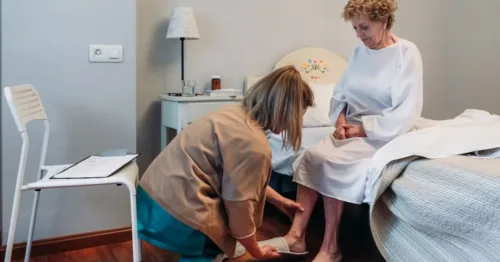
The carer can assist with washing, dressing, continence care and getting ready for the day. This means family members can prepare themselves and their children without worrying about whether their loved one has the support they need.
A live-in carer can help the person move safely around the accommodation, use mobility equipment and manage transfers. They can also help pace activities so the older person does not become exhausted.
Travelling can disrupt familiar schedules. A Care Professional can provide agreed medication reminders or support, in accordance with the person’s care plan.
Travellers taking regular medicines should prepare well in advance, carry medication in its original packaging and take supporting prescription information. Professional medical advice may also be needed before travel.
New surroundings can sometimes be disorientating for a person living with dementia. A familiar carer can provide continuity, reassurance and a recognisable daily routine.
Alzheimer’s Society advises families to consider the person’s abilities, preferences, destination and level of support when planning a holiday. It also notes that additional help may allow the person with dementia to remain supported while their main family carer has some time alone.
Not every family member will want – or be able – to take part in every activity. While younger relatives visit a theme park, go hiking or stay out late, the carer might accompany the older person for a gentle walk, a relaxed lunch or a quiet afternoon at the accommodation.
The older person remains included in the holiday without being expected to follow an exhausting itinerary.
Perhaps the greatest benefit is that a husband, wife, daughter or son can enjoy the holiday as a family member rather than acting as the primary carer throughout the trip.
Professional support does not replace family time. Instead, it helps families spend more quality time together, creating lasting memories without one person carrying the full responsibility of caregiving.
A successful trip starts long before departure. Families should consider:
Direct journeys are often easier than complicated connections, while a slower itinerary can help an older traveller enjoy the experience without becoming overtired. Familiar destinations may be particularly reassuring for someone living with dementia.
It is also important to obtain medical advice when appropriate and ensure that any travel support remains consistent with the person’s assessed needs and care plan.
An older person’s care needs may change how a holiday is planned, but they do not always have to prevent the holiday from happening.
With accessible accommodation, a realistic schedule and professional support, grandparents can continue sharing important experiences with their children and grandchildren. Families can celebrate milestones, revisit meaningful places and enjoy time together without placing the full caring responsibility on one relative.
At GoodOaks Homecare Woodford Green, Loughton & Waltham Forest, we understand how important family experiences can be. Our person-centred live-in care is built around each individual’s routines, preferences, independence and wellbeing.
For families considering a UK break or overseas holiday with an older loved one, early planning can help determine what support may be possible before, during and after the trip.
Growing older may change the way a family travels – but with the right care, it does not have to bring their shared adventures to an end.
If you’re planning a family holiday and would like to explore how live-in care could support your loved one, contact GoodOaks Homecare Woodford Green, Loughton & Waltham Forest today. Our friendly team can discuss your family’s needs and how personalised live-in care can help make travelling together safer, more comfortable and more enjoyable.